How to Draw the Head from Any Angle
This lesson has a premium version with extra content. Get it now!
11M views
lesson video
How to Draw the Head from Any Angle
coursePortrait Drawing FundamentalsFull course (35 lessons)
$65
assignments 260 submissions
Roberto C
Wanted to spice things up and make sure I maintained the volumes by animating a short turn. Done in procreate.
LESSON NOTES

Check out the Premium Portrait course to support the lessons and get access to every portrait video.

Drawing the Head

In this first lesson I’m going to attempt to summarize and simplify Andrew Loomis’ approach to drawing the head. Here we go.

If we take the head and remove the eyes, nose, lips, and ears we are left with 2 simple masses. A ball for the cranium and a boxy shape for the jaw.
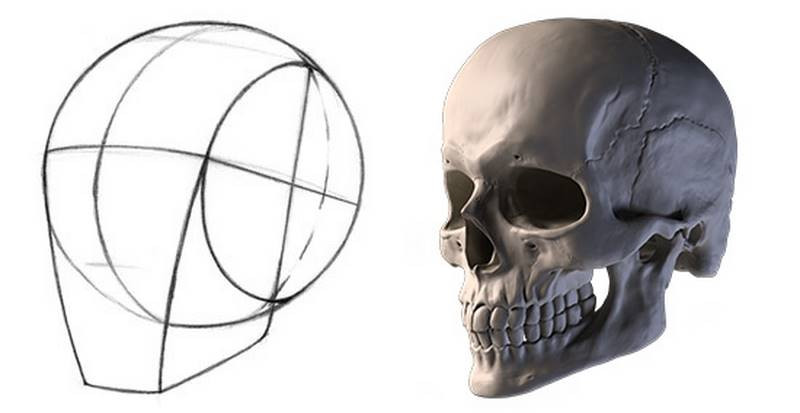
loomis head and skeleton

The cranium is spherical, but with flattened sides. So, chopping off a slice from both sides gets us a very close representation of the cranial mass.

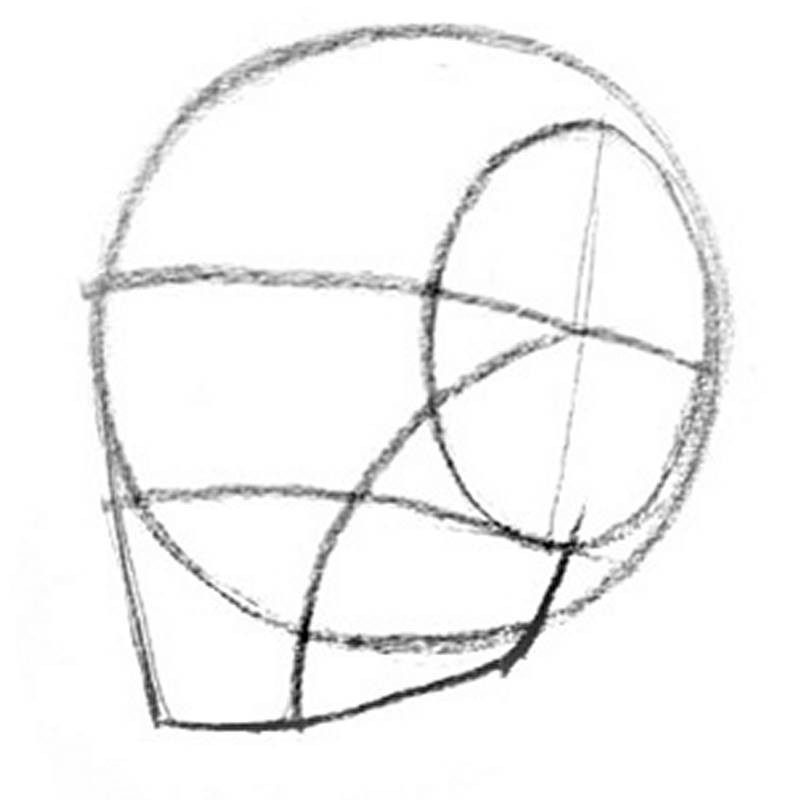
When drawing the head, I’ll start with a ball and draw an oval to indicate the flat side plane. The sizes are important here. Make sure the ball is a perfect circle. Don’t be sloppy. The oval is a bit more tricky. The height will always be the same, no matter what angle you’re drawing the head from. It’s ⅔ of the height of the circle. From the center and top of the circle, divide that area into thirds, and this will give you the top of the oval. Do the same at the bottom.

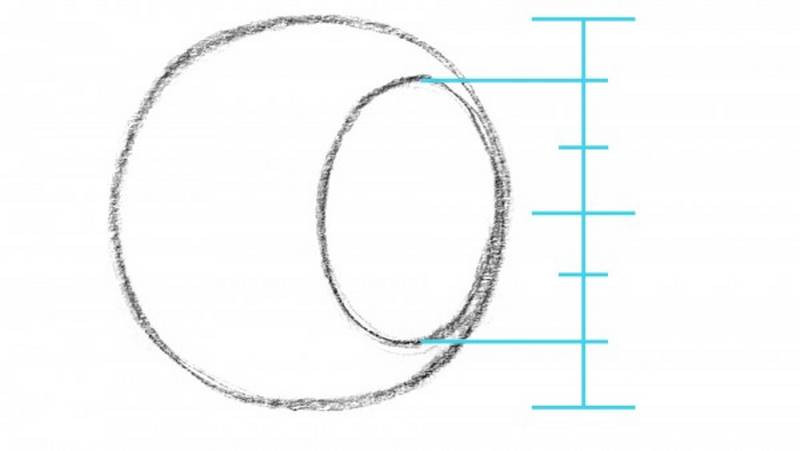
slices of the cranium
angle of the head circle measurements

Finding the Left and Right turn: The width of the oval will depend on the direction the person is looking. Compare the size of the front plane to the size of the side plane. The top portion of the oval falls on the corner of the forehead, where the front plane meets the side plane. This area is usually rounded and so it’s open to the artist’s interpretation. I've found that it usually lies near the end of the eyebrow.  The line on the front plane represents the brow so pay attention to the angle from one brow to the other.
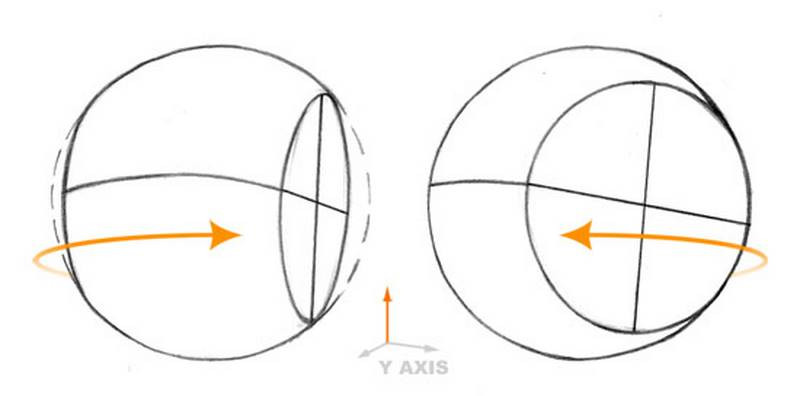
cranium side to side angles

Finding the Up and Down tilt: The vertical tilt is indicated by an angle along the side plane. If the head is tilted up, the angle will point up and if the head is tilted down, the angle will point down. The degree of the tilt will determine how steep to make this line. I like to use the angle from the ear to the brow.
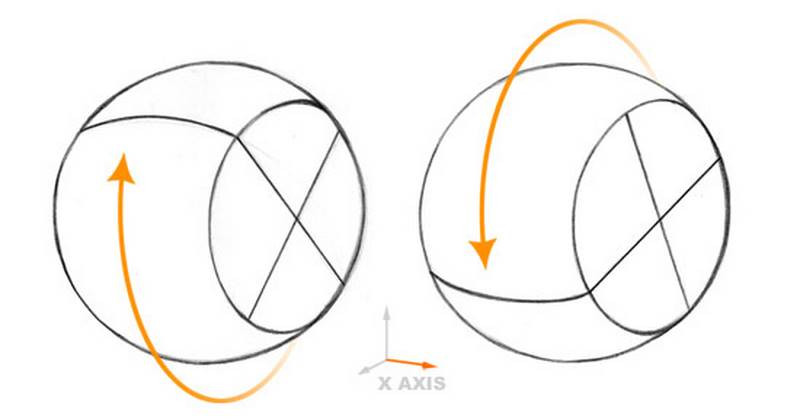
cranium tilt up and down

Then, at the base of the vertical line, draw a curve identical the the brow line. This represents the bottom of the nose. Drawing the same line again from the top of the oval brings you to the hairline.

The face can be broken down into nearly perfect thirds, chin, nose, brow, and hair.
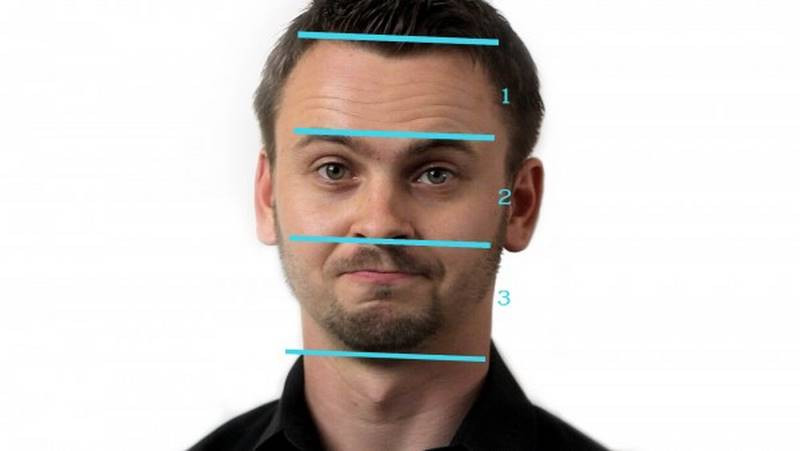
angle of the head

We can use the measurements we’ve already found to find the where the chin should be.
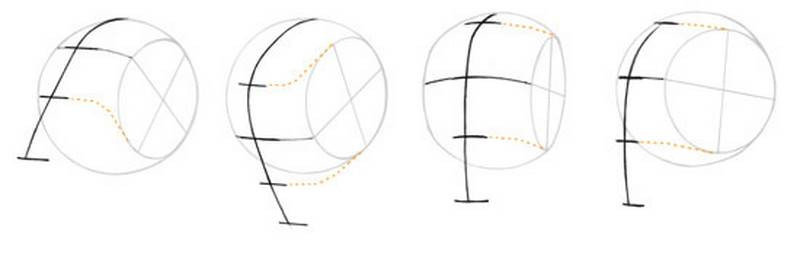
drawing chin on head

Observe the general shape of the jaw and draw in the major angles starting from the brow and ending at the side plane of the head. It’s usually about halfway into the oval, or a little bit farther back.
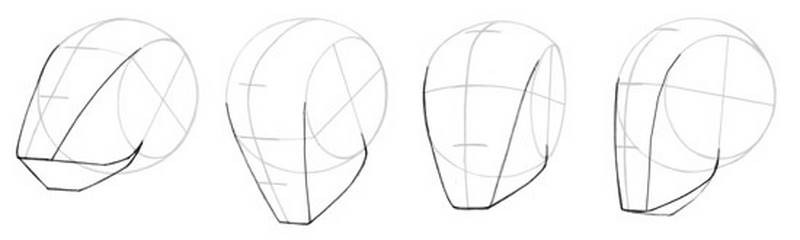
how to draw the jaw

Now that we have the foundation of the head established, we can finish it by putting in all the features! Don’t worry, I’ll explain this step in more detail next time. Each feature deserves it’s own lesson.
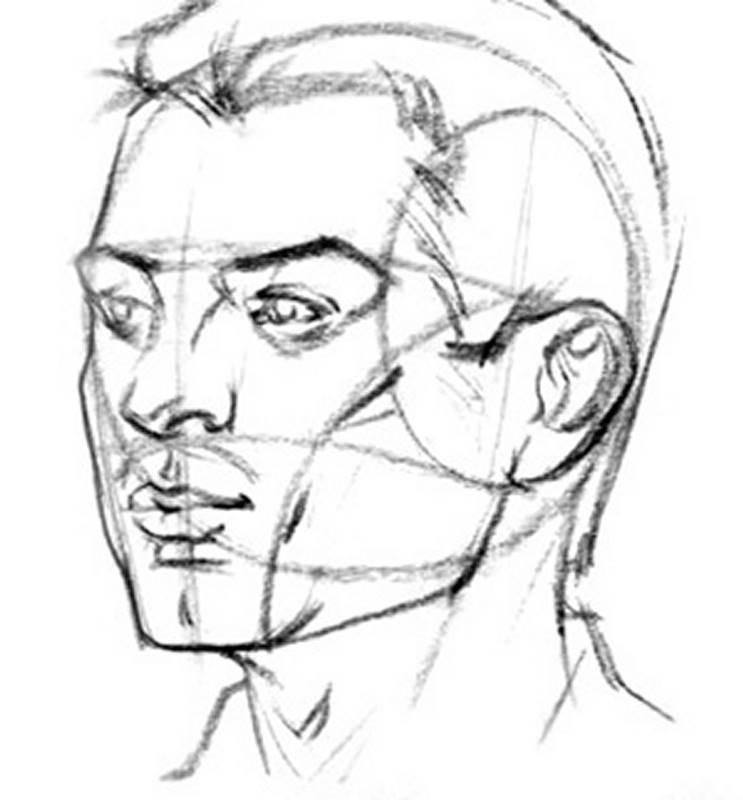
angles of the head
Let’s go through that one more time.
  1. Start with a circle for the cranium
  2. Oval for the side of the head
  3. Angle to show the person looking up or down. I’ll go with a subtle down tilt.
  4. Draw an identical curve to find the nose
  5. Double that distance to find the chin
  6. Attach the jaw
angles of the loomis head

Now you have a 3D representation of the head ready for the features. This approach is really good to establish the perspective of the head. A good exercise is to try to think about the head as a simple elongated box.
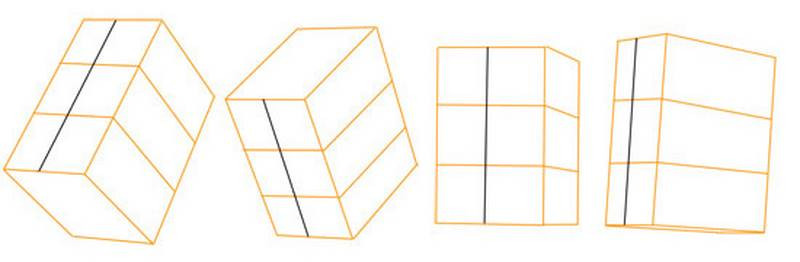
simplify the head into box

The angles on the front plane of the face such as hair line, brow line, nostrils, lips, and chin will be the same as the angles on the front plane of the box. The angle from brow line to ear is the same as the angle on side plane of the box.

These angles are really important because they establish the head as a 3-d form in space.
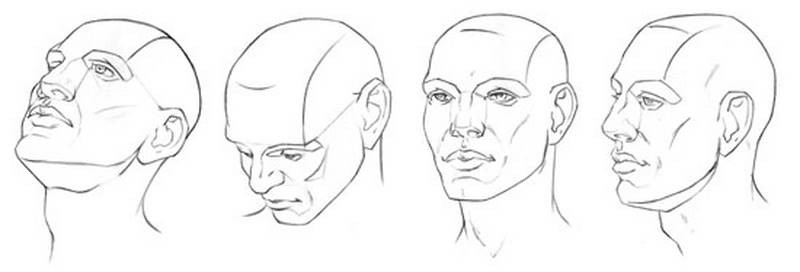
draw the head from any angle

This may seem overly technical with so many details to remember but with practice it actually becomes very easy so get that sketchbook out and practice it a hundred times with a variety of angles! You’ll find you improve much quicker than you think.
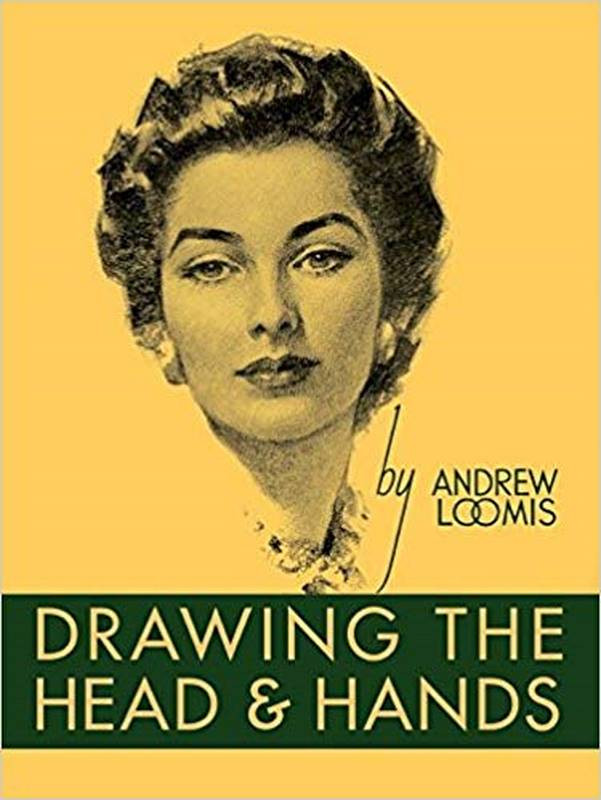
drawing the head and hands andrew loomis

Drawing the Head and Hands - by Andrew Loomis

This video summarizes this book. The full version is a great resource.

Like what you learned? Check out the next lesson How to Draw the Head from Side View!

DOWNLOADS
txt
how-to-draw-the-head-from-any-angle-transcript.txt
5 kB
mp4
Drawing the Head From Any Angle.mp4
512 MB
ASSIGNMENTS

Draw the Loomis Head

Take a bunch of pictures of either yourself or someone else and then use them to construct the head using the Loomis method. Focus on getting the up and down tilt correct. Make sure to make careful measurements that I mentioned in this video and keep your lines clean. Remember that every person has individual proportions that will be different from the average loomis head. At this point, just draw the average proportions. Once you’re comfortable with that, you can try to capture the distinct characteristics of the person you’re drawing.

If you’re having trouble drawing the circle or oval of the head, spend some at the beginning of each day warming up your hand with a lot of circles and oval.

Ami learning to draw
Today I drew the proportioned loomis head. Please give me a critique. One thing I need to improve in my opinion is to improve on drawing cranium proportion on circle. Please give any advice you can give on this. Thank You! @Rachel Dawn Owens@Melanie Scearce@Chuck Ludwig Reina@Patrick Bosworth@João Bogo
João Bogo
Hey Ami You improved a lot. Now you're starting to understand the proportions of the head. What I observed in your drawing is that the measurements are a little bit off. The upper third and the bottom third are a little too big and the middle third is a little too small. To fix it you need to bring the hair line and the nose line down and the jawline a little bit up. Little adjustments don't go crazy with it. There's a point I think you misunderstood. The line of the mouth is 1/3 from the nose line to the jaw line. What aligns with the bottom of the circle is the end of the bottom lip. I know measuring isn't fun but at this point you need to measure a lot and lots of repetitions to hammer this measurements in your head. Eventually you can do this unconsciously. So draw this front view, side view and 3/4 a lot and try to keep the measurements consistent. Ignore features for now and use the 3d model as a guide. Keep drawing and best regards.
Ami learning to draw
Hi! Today I drew average proportions of male head by using the perfect thirds. I will show you what steps I did to draw the average proportions head so that it will be easy for you to give me a critique. Also please tell me any effective techniques you know on how to add the perfect thirds proportions on a head. Thank You! @Rachel Dawn Owens@Chuck Ludwig Reina@Melanie Scearce@Patrick Bosworth
Patrick Bosworth
Hey @Ami learning to draw Take another look at the Loomis video series, here's the original "How To Draw The Head From Any Angle" where Stan covers the basics of the Loomis construction, and then another video where he puts it to use over a few examples "Quickly Draw Heads with the Loomis Method – Part 1." First watch these without drawing during the video so you can take the information you already know and really see it done in real time. Once you've watched it once then watch them again while you draw along. The second video really shows how Stan uses it when looking at a portrait model, so you can get an idea of how these guidelines work. https://www.proko.com/course-lesson/how-to-draw-the-head-from-any-angle https://www.proko.com/course-lesson/quickly-draw-heads-with-the-loomis-method-part-1
João Bogo
Hey Ami I can see how you're having difficulties with this because you're making mistakes in the conceptual level. Let's correct them shall we? First, steps 1 and 2 are correct. Step number 3 is where things start going awry. The nose line is 2/3 down from the center line. Not in the bottom of the circle. From the from that's when the mouth ends. So a good step 3 should be: _ Divide the upper half of the circle into 3 parts. _Divide the bottom half into 3 parts _ middle line is the brow line _2/3 up the middle line is the hairline _2/3 down the middle line is the nose line Now to the step 4. Here's you making another mistake. The head according to Loomis is 3 and half units tall. Not 3. Remember, we divided the upper half of the circle into 3 parts. 2/3 is a perfect third from the brow to the hair line and 1/3 is hair line do top of the head. It's half a third. The math adds up. So step 4: - to find the chin: Double the distance from the nose line to the bottom of the circle or Double the distance from brow to nose. _ eye line: either halfway of the whole height of the head or divide the middle third into 4. The eye line will be in the first 1/4 _ Mouth: for the opening of the mouth. Divide the bottom third into 3. The line will be in the first 1/3. The end of the bottom lip will be halfway point of the bottom third. Or if you measure everything right it's the bottom of the circle. I include a plate from the Loomis book "drawing head and hands" to help you visualise. If you have money to spare, that's a good book to have. Keep drawing and best regards
Ami learning to draw
Hi! Today I finally drew the average proportion of male head according to Andrew Loomis. I drew the front and side view. I saw brokendraw video to understand more about loomis head proportion. There is one thing I want to know. How to know and place the Perfect Thirds on the loomis head? Thanks! @Rachel Dawn Owens@Melanie Scearce@Chuck Ludwig Reina@Patrick Bosworth
Chuck Ludwig Reina
Nice work! The perfect thirds are a tricky thing with Loomis in that they actually don't go to the top of the head. The go to from the top of the hairline to the top of the eyebrows. Also, be mindful of where the eyes are. They are generally in the middle of the head, from the top of the head to the bottom of the jaw, and more inset into the skull. Good stuff, keep it up!
Ami learning to draw
First time, I drew turnarounds of Loomis heads! Please give the critiques because this helped me a lot in improving my drawing skills! Thanks! @Rachel Dawn Owens@Chuck Ludwig Reina@Melanie Scearce@Patrick Bosworth
João Bogo
10d
Hey Ami Very nice attempt. They look very solid and the line quality is very good. Although sometimes you lose control of it's thickness you're drawing confidently. Keep up. The problem with your drawing is proportion. Remember the perfect thirds? From hairline to brow, brow to nose, nose to chin it's the same distance. In yours you're drawing the middle third too small and the bottom third too large. The line of the nose should align with the bottom of the elipse. Once you have it just measure the middle third and repeat it down so you can find the chin. You didn't include a profile view. You need to study it to understand better 3/4. Keep drawing and Best regards
Knighty Shiny
Hii this is my day one! Critique welcomes and wanted i struggled the most figuring out how to draw the loomis head looking up! It looks like that one frieren meme.. lol
@bfoxart
3mo
Some studies using the 3d Loomis head.
Christian R
I did 8 more heads in a continuation of this assignment. Any suggestions would be welcome. Thanks!
Carlos Javier Roo Soto
You are doing great. I would say that when trying to learn the Loomis head the best approach is to focus on just the construction without the details and features. You can keep practicing with the features, but I recommend doing sessions dedicate exclusively to getting down the simple head construction and proportions of placement without the features, and other sessions dedicated to actually placing the details. And when you practice placing the features, make sure you have corrected your proportions in the early stages of your sketch before committing to drawing any features. Good luck.
Christian R
Loomis Heads for the exercise. Any feedback is appreciated. Thanks!
Michael
3mo
I like the app timer it’s good for different positions
Michael
3mo
Started the course today, exited to join this community! Started the first couple with the 3D loom head en then I used the timer tool for photo reference. The timer to makes it allot more fun for me with the two minute timer. I think I should stick with only the average proportions but to see what is what I draw some eyes and noses. All tips is welcome 🙏 thank
Vue Thao
3mo
Avoid adding facial features such as the eyes, nose, and mouth. They're merely a distraction. Just focus on the construction of the Loomis method.
Christopher Corbell
Here's a page of my drawings for this assignment. These are all from reference - I'll try to do some original photos and keep practicing. I completed Michael Hampton's Head Drawing and Construction course before this one and found his alternative or variations on the Loomis approach really helpful too. I think lots of practice with different methods is helpful, there's getting the idea at first and then there's the repetition that makes it start to become natural.
Kyle McCollum
Feeling accomplished. I was able to understand why my first front facing head was so narrow and adjusted accordingly on the next one.
Patrick Bosworth
Nice adjustment, the second front facing head has great proportions! Once you internalize the basic framework, you can adjust it on purpose to fit different character types, or to suit the particular portrait you're working on. Keep it up!
Ami learning to draw
Hi! Today with the loomis method, I drew 3 portraits using photo reference. I drew some plains to get depth in face drawing. But I couldn’t draw the plains on side view. Please critique my drawings. Thank You! @Patrick Bosworth@Melanie Scearce@Rachel Dawn Owens
Chuck Ludwig Reina
Nice drawings Ami. One thing I would look out for , is how big the circle that represents the cranium is. The head is often much larger and longer than we realize. The jaw should only extend about a third longer than the height of that circle. Also note, the eyes are generally about half way between the top of the head and the bottom of the jaw. Keep it up!
Ami learning to draw
Hi! I first want to thank @Patrick Bosworth and @Melanie Scearce for telling me to start and master level 1 for drawing head! How right they are! Anyways, today I drew many loomis heads. Please critique my head drawings! Thank You! @Patrick Bosworth@Melanie Scearce@Rachel Dawn Owens@Chuck Ludwig Reina@Martha Muniz
Patrick Bosworth
Really nice progress, Ami! You're really starting to get the hang of the framework, and the tilt of the head! Great job! Keep practicing with this basic framework, try to draw it in as many different angles as you can, look at photos and try to draw the Loomis head in the same orientation as the people in the photos, and have fun with it! Keep up the good work!
@ink555
5mo
I tried to draw some more extreme angles butttttt yeah didn't work so well. Oh well I can always practice more🤷🏼‍♀️
Unexpected Koi
These look really good. Have you tried the model loomis head you can pose? It lets you see exactly what needs to be adjusted.
Jon Passig
7mo
I've been drawing for a few years now but am embarrassed that I still don't have the structure of the human face memorized. I plan on doing another 50-200 of these until I get it right but could I get some help with these? I have a hard time visualizing what I'm supposed to do to account for the slice off the opposite end of the head. Also just general critique would be more than appreciated. Thank you!
@athrillingepisode
100 times like you said, the more i did it the less i had to erase, as you can see in the later heads less smudges😂😂, but i actually learned a lot with this assignment, thank you.
@feawi
11mo
Just some sketching practice of the head using the Loomis method, trying to play around with the shapes of the head
Nate Ferguson
This first step has actually tied in perfectly for an assignment in the Drawing basics course, Simplifying a portrait from observation!
Nate Ferguson
I can tell that I'm gonna need to do this a whole bunch, like everything else I guess. I do love the break down of the shape of the head into digestible parts. It's like a base layer blueprint which is nice. I'll try and incorporate this into my sketch warm-ups each morning.
@navyservant61
That’s good,bro!!!
Help!
Browse the FAQs or our more detailed Documentation. If you still need help or to contact us for any reason, drop us a line and we’ll get back to you as soon as possible!