Anatomy of the Shoulder Bones
This lesson has a premium version with extra content. Get it now!
492K views
lesson video
Anatomy of the Shoulder Bones
courseAnatomy of the Human BodySelected 3 parts (371 lessons)
-9%
$434.07
$477
You save $42.93
assignments 59 submissions
Manuel Rioja
Assigments ready...
LESSON NOTES

We’ve already studied the spine, pelvis and rib-cage. This lesson on the shoulder girdle, will complete the bones of the torso. Very soon we’ll move on to muscles!

Simple Structure of the Clavicle
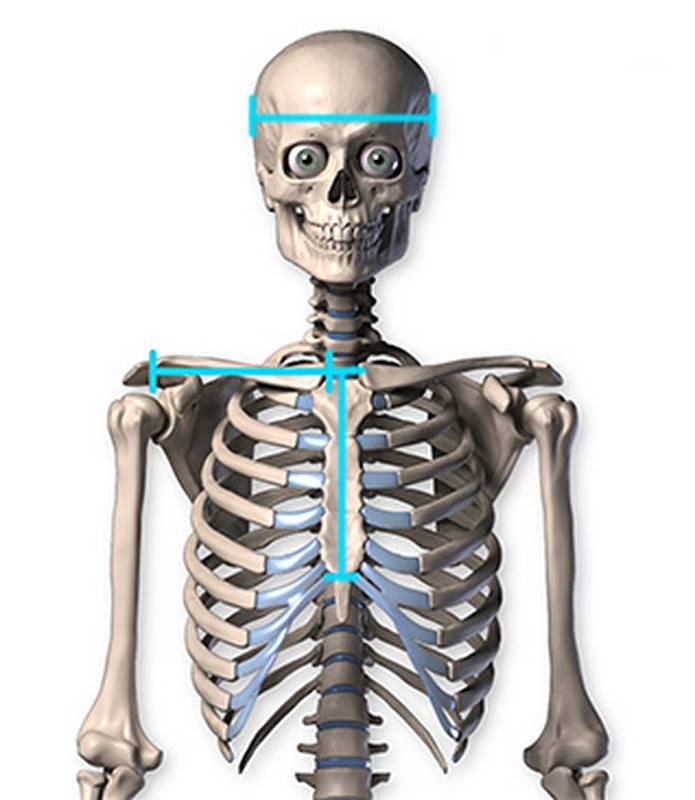
clavicle Length

Let’s begin with the clavicle, because that’s where the shoulder begins. A clavicle in its least foreshortened position, is about one cranial unit… more or less, which is about the same length of the sternum… more or less.

That’s the advantage of having them near each other on the front. They’re convenient to compare.

But unless we’re looking at the chest from the front, one of these is likely to be foreshortened. So we need to think of clavicles as fore-shortenable sticks.
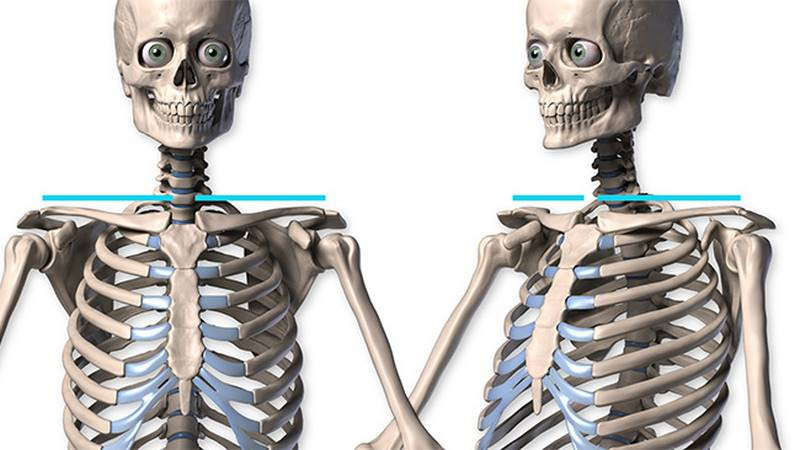
clavicle perspective

But a clavicle is not a straight stick. It has three parts that are offset. In fact, when you put them together, they make the shape of a Cupid’s bow.
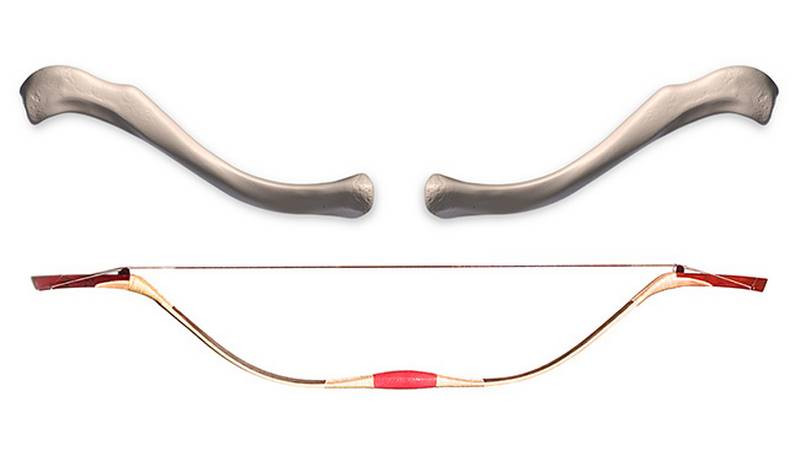
clavicle bow

If love is not your thing, the clavicles also look like a pair of bicycle handlebars.

And since they wrap around the base of the neck like the collar of a shirt, we call them collarbones. That’s the first bone of the shoulder girdle: the clavicle.
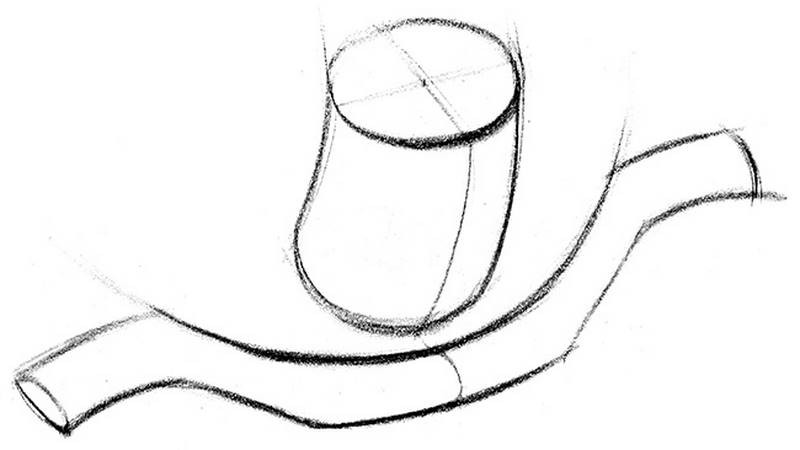
coller bone

Simple Structure of the Scapula

Now let’s move to the dominant bone of the shoulder girdle: the scapula. The scapula is also known as the shoulder blade. We can simplify it as a triangle that’s about a cranial unit high, and about a cranial unit wide, and when the scapulae are in the neutral anatomical position, they are about a cranial unit apart… more or less.

Here’s a comparison that may help. The scapula is about the size of a cupped hand, which conveniently matches its concavity to the convexity of the rib cage.
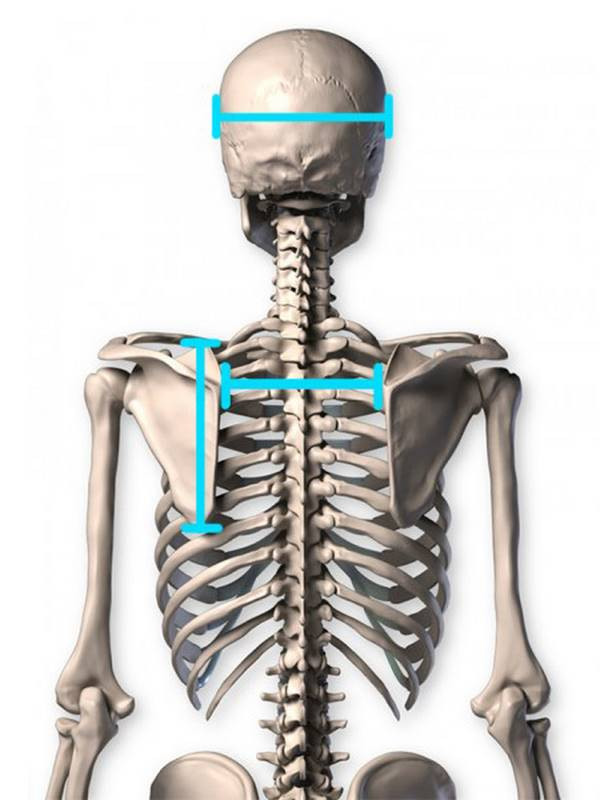
scapula size
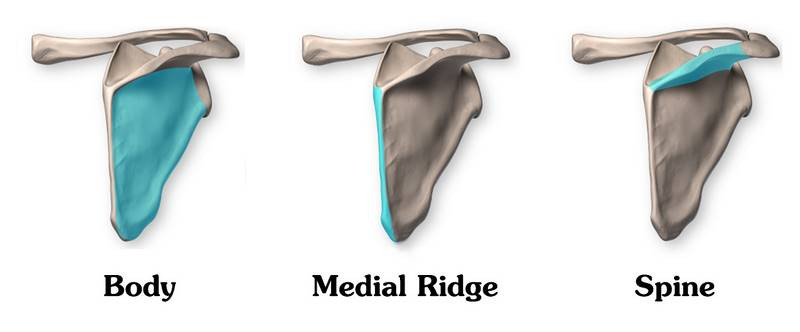
scapula parts

The scapula is all one bone, but for artists, it has two distinct sections. The body of the blade is here, mostly deep below the surface, except this medial ridge. The spine of the scapula is almost a bone of its own. It sticks out like a trowel handle that you can tap along the surface. That’s the spine of the scapula… Sub-cutaneous and super-important.

scapula length

Now, when we combine the scapula and clavicle, they sit on the rib cage like shoulder pads. The rib cage is thinnest at the top end, but with the shoulders, the thorax is widest at the top.

The shoulder girdle is usually bigger in men than women, though it might not give any advantage in a fight…

Anatomical Details of the Clavicle

Where do you think the arm begins?

The arm begins at the pit of the neck! This is the only bone-to-bone connection of arm to the trunk. The rest of the shoulder girdle never touches the rib cage – a network of muscles lies between them and secures them together.

The pit of the neck is simple, but it has some pit-falls.

pit of the neck

You may know that the sternomastoid tendons make a V shape in there, but only when they’re tensed, and they’re not always tensed. Watch for a box-shaped pocket…
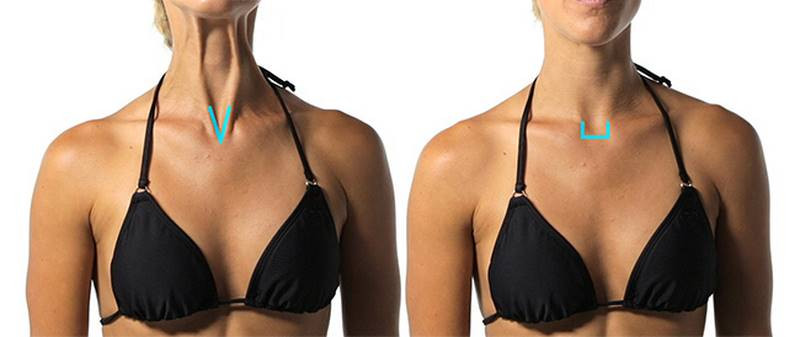
sternomastoid tendons

Don’t place them too close together. Clavicles don’t touch each other. They attach at the corners of the manubrium, spread out a good two-fingers-distance from the center. An eyeball could fit in there.

Ligaments strap the clavicles to the sternum. They allow it to rotate on its ellipsoid joint, and smooth out the bumpiness. So this area is usually smooth.

Clavicles are subcutaneous all the way across. They anchor muscles from the neck and chest, and serve as very important landmark lines.

 Anatomical Details of the Scapula

When we get to the end of the clavicle, we reach the acromion process. It seems like an extension of the clavicle, but it’s actually an extension of the scapula – the furthest reach of the spine of the scapula. The acromion process is a flat rectangular platform that “steps down” from the clavicle.
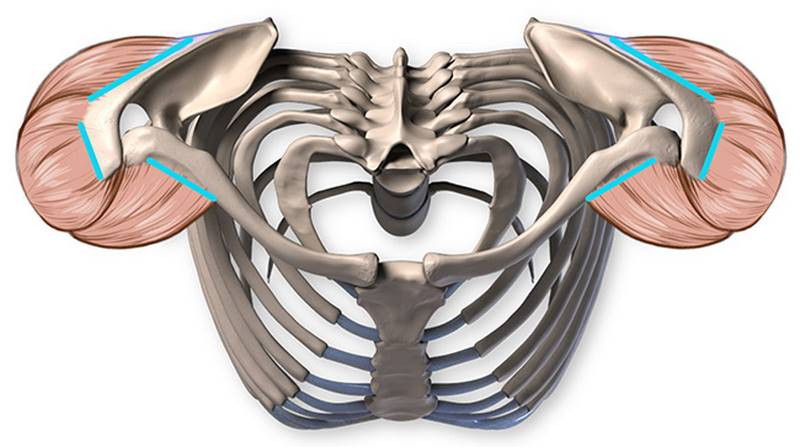
14 shoulder top view
From a top view, we can see the boxiness of the acromion process as the deltoid muscle wraps around it to attach to the front plane, side plane, and back plane. If you remember from the Figure Drawing Course, we used this landmark to identify the top plane of the robo bean.

Let’s look at the Spine of the Scapula in more detail.

spine spacula

The spine on a human scapula twists from back to top. This means the spine of the scapula is a complex plane, like a ribbon on a cylinder.

This may be hard to draw, but it’s valuable. That rolling plane affects the surface, and helps an artist know how the light changes as it twists.
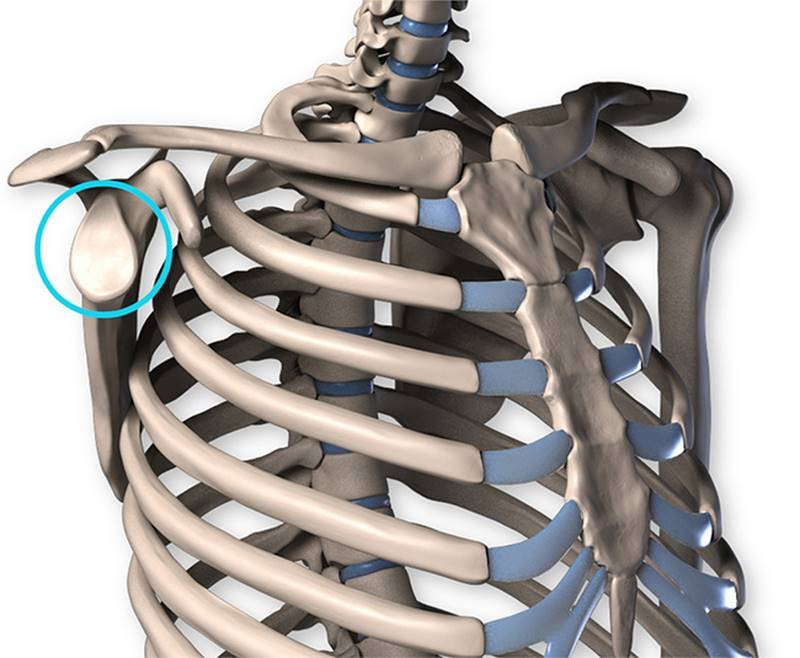
glenoid cavity

The glenoid cavity is the socket that holds the humerus. It has a shallow socket, not good for supporting weight, but great for mobility. The head of the humerus is a ball that fits into that socket, just below the acromion process. And since the socket is shallow, we have a network of ligaments called the rotator cuff that secure the ball of the humerus to the glenoid cavity.

Now, here’s the super important thing about the scapula. The blade, specifically the medial border, and the spine are the primary landmark lines. They make a fixed angle, more than 90°, and when the scapula moves, that angle stays fixed…
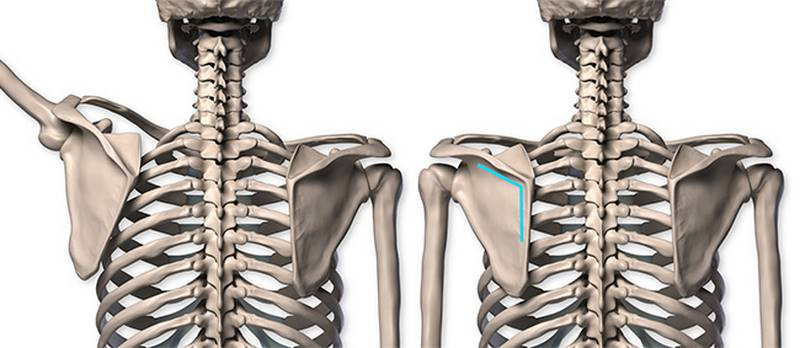
scapula alignment

So, how the heck do we find these lines on a model? Where’s the scapula in this crazy mess of bumps? A lot of the scapula is covered with a mesh of muscles, but these lines will always be visible. In some poses, especially on muscular or heavy people we’ll see them as indentations. The trapezius attaches along the spine of the scapula. Rhomboids attach along the side. A group of scapular muscles sit on the inside of the blade. And the deltoid attaches along the bottom of the spine.

In other poses and especially on very lean people, the bones project outward, since the volume of the muscles is thin or stretched.

scapula pop

Motion

To learn about the impressive motions of the scapula, head on over to proko.com/anatomy. In the premium anatomy course, each lesson has extended videos, more drawing examples, and 3d models that you can rotate and draw from any angle. Really check it out!

DOWNLOADS
txt
Shoulder-Bones-Premium-Transcript.txt
10 kB
zip
Shoulder-Bones-Assignment-Images.zip
349 kB
mp4
Anatomy of the Shoulder Bones - 1080p.mp4
279 MB
ASSIGNMENTS

Assignment

First, draw the ribcage. Then, draw the shoulder girdle on top of the ribcage. Draw around to the other side, ghosting it as it goes around. Look for angles and landmarks, and draw them as three-dimensional forms. We’ll need to master this before we include muscles. Think about it – the positions of the bones determine the shape of the muscles. When we can draw the clavicle and scapula as forms, we have the underlying structure that shapes the shoulders. Make sure to use the assignment images in the downloads tab.
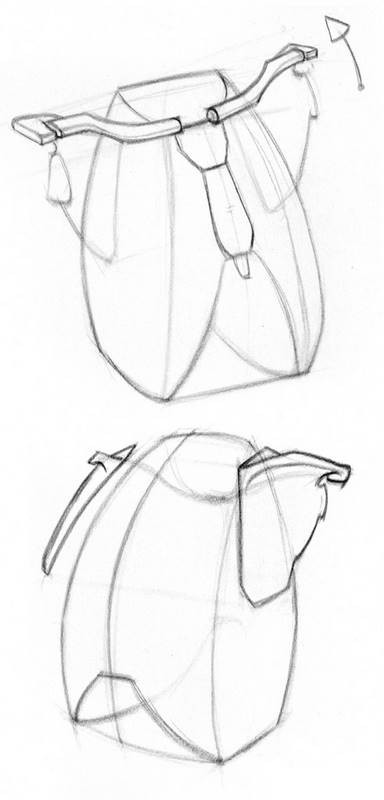
sholder bones assignment images

Anthony
18d
Daniel Cabot
Lots to learn photos 1 to 4
João Bogo
21d
Very good You did a good job in the ribcages. They feel very solid. The shoulder bones have room to improve. On to the critique. I feel that you're still shaky in the format of the Rib cage. You drew numbers 2,3, 6, 7, 8 almost triangular. It should be more ovoid. The idea however is not wrong. There's a curve about in the bottom 1/3 but remember to round the corners. Also you're flattening 2 and 3 and I think 8. It should be a little fatter front to back. Now. The shoulder bones. The impression I get is that you don't know how and where to place the shoulder bones. A lot of these exercises they feel flat and they're the wrong size. Remember all of these should fit inside a human body. Try starting simplifying the ribcage and the shoulder into two boxes (it should look like a T) then you fit the ribcage and the shoulder bones inside of them. Think like a sculptor, you're gonna start with a big piece of clay, mold it into general forms and then sculpt the particular forms. Essentially we're guessing from big to small. Also draw bigger. The fact that you're drawing small is hurting your drawing because is leaving you no space to draw information that could strengthening your drawing. For example: we show structure by using corners and cross contours. You drew the clavicle flat. If you have drawn it bigger you could use cross contours to show the cylindrical form or the rectangle cross section. That's it. You're in the right track. Try using the 3-d model if you can and keep trying. Don't obsess over it. This is more an exercise of drawing 3-d forms than anatomy per se. Like, when you're drawing the body you're just gonna see hints of these forms. Keep drawing and best regards
Daniel Cabot
5-10
Kianna Peppers
https://www.youtube.com/@TheCrystalLibrary-STREAMS?sub_confirmation=1 I’m revisiting Proko’s anatomy course after completing it over the past 5 years. I'll be reviewing the lessons in real-time every Sunday on YouTube. Not trying to compete, just happy to be a Study Buddy! :)
Daniel Cabot
Your awesome
Amortquio Flores
@j0shb0i
5mo
Sita Rabeling
This is a great exercise! Thnx for this idea :)
Celumie
5mo
To me this was THE hardest assignment so far i feel like i got it somewhat but ill need to revisit it at a later date
Sebrighted
9mo
external studying was needed for sure, interestingly the scapula doesn’t move as much as I imagined, it rotates from a pivot point on the top left in the back
Brandon
1yr
The scapula is the most difficult one... all those bumps from the back and wrapping around the ribcage. I need to go back to do some muscle tracing actually to know whats going on. And the movement of it is another tricky part, kind of gliding everywhere. Mostly I am just guessing, and see some 3d movement videos to get a sense of it. Any tips for the movement part, coz I still cannot draw them from imagination...
@fifiyellow
@nahgul7
1yr
Having a hard time finding the shoulder bones underneath all of the muscle and skin, feedback appreciated!
@chinanoahli
I think I made the shoulder blades too small. But the distance between the landmarks in the reference photo doesn't seem to be that big.
Sita Rabeling
The muscles look good to me. Maybe this photo helps for the scapula.
SolisUmbra
1yr
This assignment was more difficult than I thought. I’m not too happy with my drawings, I think they look too flat but I’ll move on to the next lesson
Tom Simpson
I decided to do the shoulder bones excercises as tracings in the first instance. Please let me know if you see any mistakes I am repeating!
Rachel Dawn Owens
These look awesome! You will learn so much from tracings like this
Giorgi Karkuzashvili
Consistent practice is key!
@maximilienle2d
didn't really succed, I was always off from the examples given by stan. I will have to try again once I forget about the corrections
hArtMann
2yr
Definitely the hardest bones from the torso.
Yoyo Yang
2yr
Yoyo Yang
2yr
Any critique is welcome~ Thank you!
@batman921
2yr
Quick question. Does anyone know what movement causes a posterior tilt of the scapula? The other scapulothoracic movements are clear, but this one still eludes me somewhat.
@lazy0
2yr
The Reference photos are in order from 1-6. I would like honest feedback please don't hold back. The front of the models for me are pretty hard especially when the Scapula's are foreshortened. I also have a difficult time with angling the Clavicles because sometimes I don't know the length of them. Also are the Scapula spines I constructed good? or could it be better, pretty difficult from foreshortened angle. Feedback needed please I need help.
@jasonpl4
2yr
It is particularly hard to figure out how to draw the scapular in simplified forms. I did some corrections after the critique video. It has been really helpful for me to spot my mistakes, but one thing I don't really understand is whether the clavicle can be lifted that high as the demonstration suggests in the #5. I tried to lifted my own shoulders and the clavicle seems to be barely moved.
Cseri Zsolt
Hi! The bottom of the scapula will move lateraly in picture #5. That will bring the spine of the scapula closer to the neck. On the model, you can clearly see the trapesius muscle. The end of it, is basicly the start of the scapula. Other than that, you should look out for proportional issues. As far as i remember, the scepula should be around 1 cranial unit, The rib cage is around 2 cranial untis. If you want to go deep in anatomy, you should also check the form of the spine of the sceupla, but i guess you can move on as well. You will always have to back to preversius lessons from time to time when you are learning. Hope it helps, have a nice day
Help!
Browse the FAQs or our more detailed Documentation. If you still need help or to contact us for any reason, drop us a line and we’ll get back to you as soon as possible!